Solving Rational Equations
Rational equations are simply equations with rational
expressions in them. We can use the technique outlined earlier to clear the
fractions of a rational equation. After clearing the fractions we will be left
with either a linear or quadratic equation that can be solved as usual.
| |
 |
|
| |
 |
|
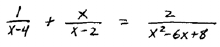
| Step 1: Factor the denominators. |
 |
Step 2: Identify the restrictions. |
| |
 |
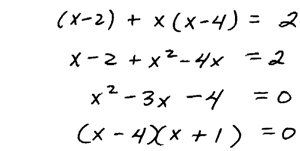
Step 3: Multiply both sides by the
LCD. |
  Step
4: Solve like normal. In this case solve the resulting quadratic
equation. Step
4: Solve like normal. In this case solve the resulting quadratic
equation. |
 |
|
| |
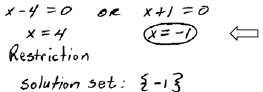 |
Step 5: Check answers against the
restrictions. |
This process sometimes produces answers that do not solve
the original equation, so it is extremely important to check them. Tip: It
suffices to check that the answers are not restrictions to the domain of the
original equation.
A. Solve
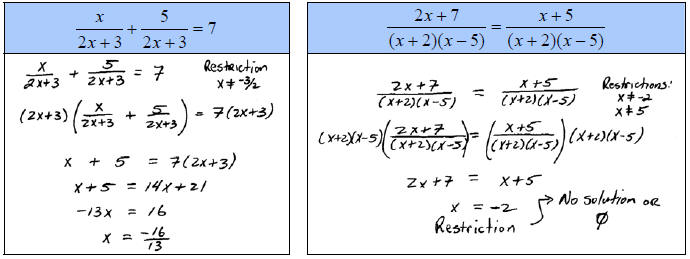
Determining the LCD is the step that most students have
difficulty with. When deciding what the LCD is, use one of each factor, make
sure that when we multiply it cancels with all the denominators and clears the
fractions. If it does not, the LCD is incorrect.
B. Solve
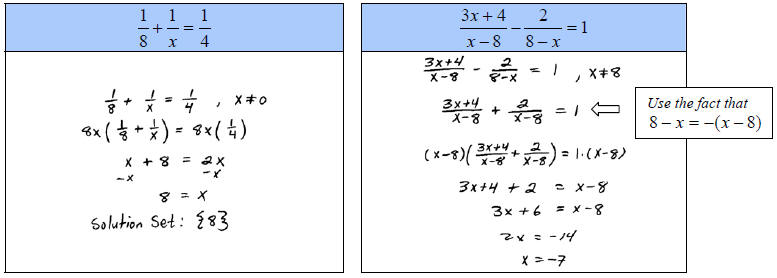
If we multiply both sides by the LCD we would next
distribute it through the expression. We can save this step and simply multiply
every term of the rational expression by the LCD as illustrated below.
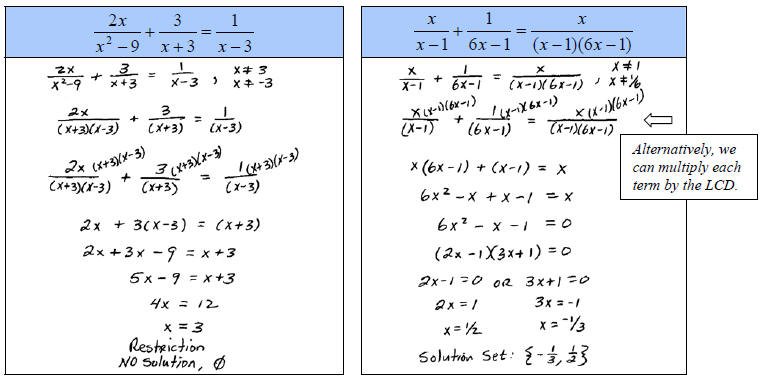
It is tempting to simply multiply all the factors of the
denominator together to obtain a common multiple. This will work, but usually
leaves us with an equation that is too cumbersome to work with. If we use the
Least Common multiple of all the factors in the denominators then we will have
less factoring in the end. Bottom line, it is worth spending the extra time to
find the LCD.

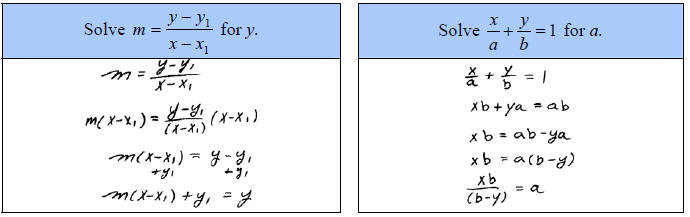
Some literal equations, often referred to as
formulas, are also rational equations. Use the techniques of this section and
clear the fractions before solving for the particular variable.
C. Solve for the specified variable
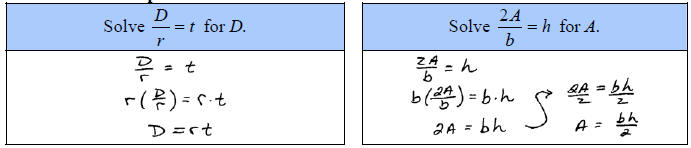
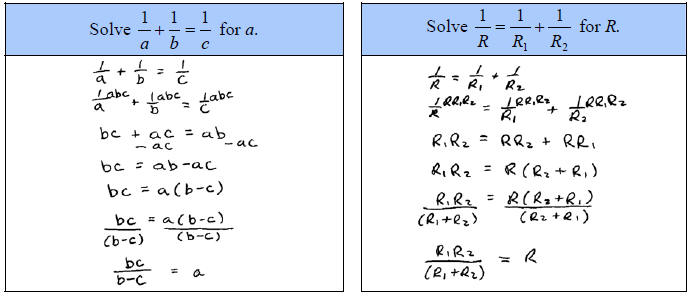
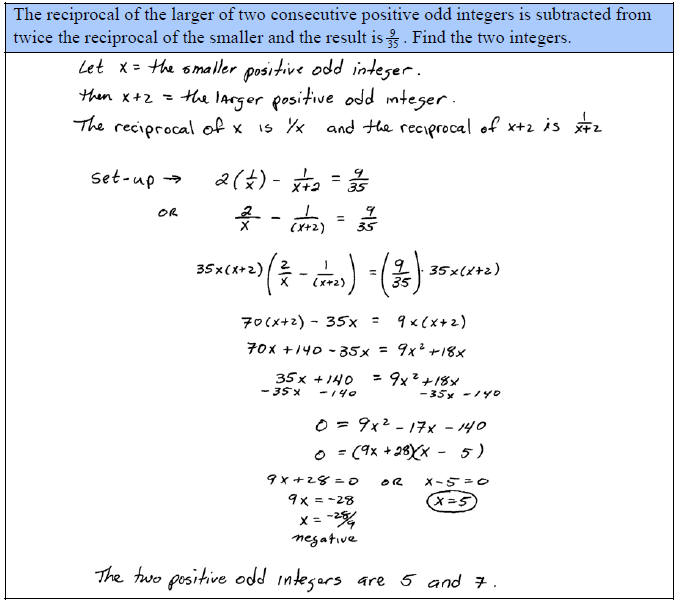
The reciprocal of a number is the number we obtain by
dividing 1 by that number. Often we think of the reciprocal as an interchange of
the numerator and denominator but this definition fails us when the number to be
reciprocated is a variable.
C. Typical Number Problem
|