Solving Systems of Linear Equations In
Three Variables
The solution to systems of equations to this point
involved two-dimensional intersections of at least two lines. Recall that there
were several possible outcomes:
1.) Intersection at a single point (an ordered
pair).
2.) Infinite solutions because the lines were the same.
3.) No solution because the lines were parallel.
In systems of linear equations in three variables the
desired solution is an ordered triple (x, y, z) that exists in three-dimensional
space. The best way to imagine this is to think of the point as a corner of a
box.
The outcomes for these systems of equations are:
1.) An intersection at one point (an ordered
triple).
2.) An infinite set of solutions (Dependent). This occurs when:
a.) All three planes cross at a common line.
b.) All three planes are the same.
3.) No solution (Inconsistent). This occurs when:
a.) Two or more of the planes are parallel and/or are cut by the third
plane.
b.) No planes are parallel but two intersect in a line that will be
parallel to the third plane.
The following example will show a method to use to
determine which of these outcomes results from the solving of the system. The
key element to the procedure is the elimination-by-addition method covered
previously.
NOTE: Not all problems will have an ordered triple
as a solution!!
Example 1: Solve the following system of equations.
4x + 8y + z = 2
x + 7y – 3z = –14
2x – 3y + 2z = 3
Solution:
Step 1: Number the equations.
The equations are numbered to keep track of them during
the solution process.
If this is not a problem for you than skip this step.
1) 4x + 8y + z = 2
2) x + 7y – 3z = –14
3) 2x – 3y + 2z = 3
Step 2: Determine a variable to eliminate.
Unless otherwise directed, select a variable that is easy
to eliminate if any two
of the given equations are added together. Some helpful suggestions are
selecting a variable that is missing from one or more of the given equations or
one whose coefficient is one or finally one that appears as positive in one
equation and negative in another. For this example, z is selected.
Step 3: Create an equivalent equation or equations
whose sum eliminates the
selected variable.
For this example equation 1 will be multiplied by the
number three then added
to equation 2 to achieve a sum that has no z term.
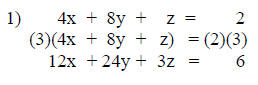
This is the equivalent equation 1 that is now added to
equation 2. Their sum
will be known as equation 4.
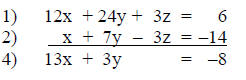
Step 4: The equation not used in step 3 (in this
example equation 3) must now be
added to either equation 1 or 2 to eliminate the same variable. Use
equivalent equations if necessary.
In this example an equivalent equation of equation 1 will
be used. This
equation is found by multiplying it by –2. The equation will then be added to
equation 3 to eliminate the z variable. The sum of these equations will be
known as equation 5.
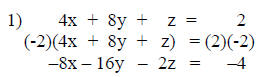
This is the equation equivalent to equation 1.
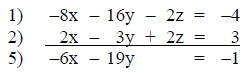
Step 5: Equations 4 and 5 are inspected to determine
which variable can be
eliminated with the least amount of effort.
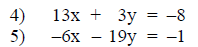
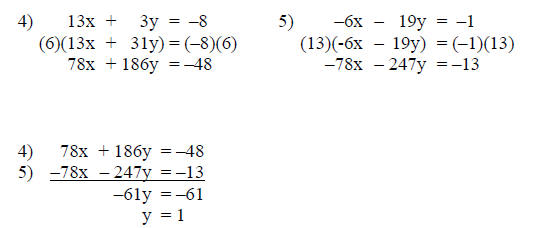
For this example, the x term will be selected. To obtain
equivalent equations
whose sum will eliminate the x term, equation 4 is multiplied by six an
equation 5 by thirteen. The sum of these equations will be the value of the y
variable.
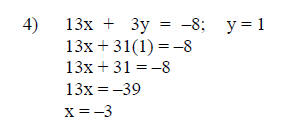
Step 6: Solve for a second variable.
The solution of a single variable in step 5 (for this
example y = 1) is substituted
into either equation 4 or 5 to solve for the second variable. For this example,
equation 4 is used.
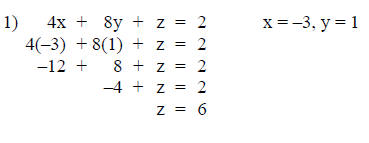
Step 7: Solve for the remaining variable
The solutions from steps 5 and 6 ( x = -3, y = 1 ) are
substituted into either
equation 1, 2 or 3 to solve for the remaining variable, z in this case. Equation
1 will be used for this example.
Step 8: Verify the solution set.
Substitute the solution from steps 5, 6 and 7 into both
equations not used in
step 7 (in this case equations 2 and 3). This substitution must be made
to
verify the type of outcome this system represents.
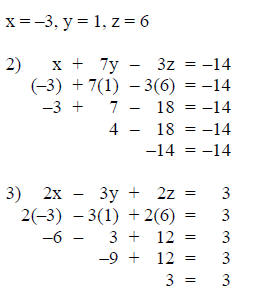
Since the solutions in step 8 are both true, the solution
is an ordered triple
(-3, 1, 6).
If the outcome had been a false statement, such as 0 = 3,
this would indicate an inconsistent system.
If, when finding an equivalent equation, one given
equation is found to be the same as another, this represents a dependent system.
|